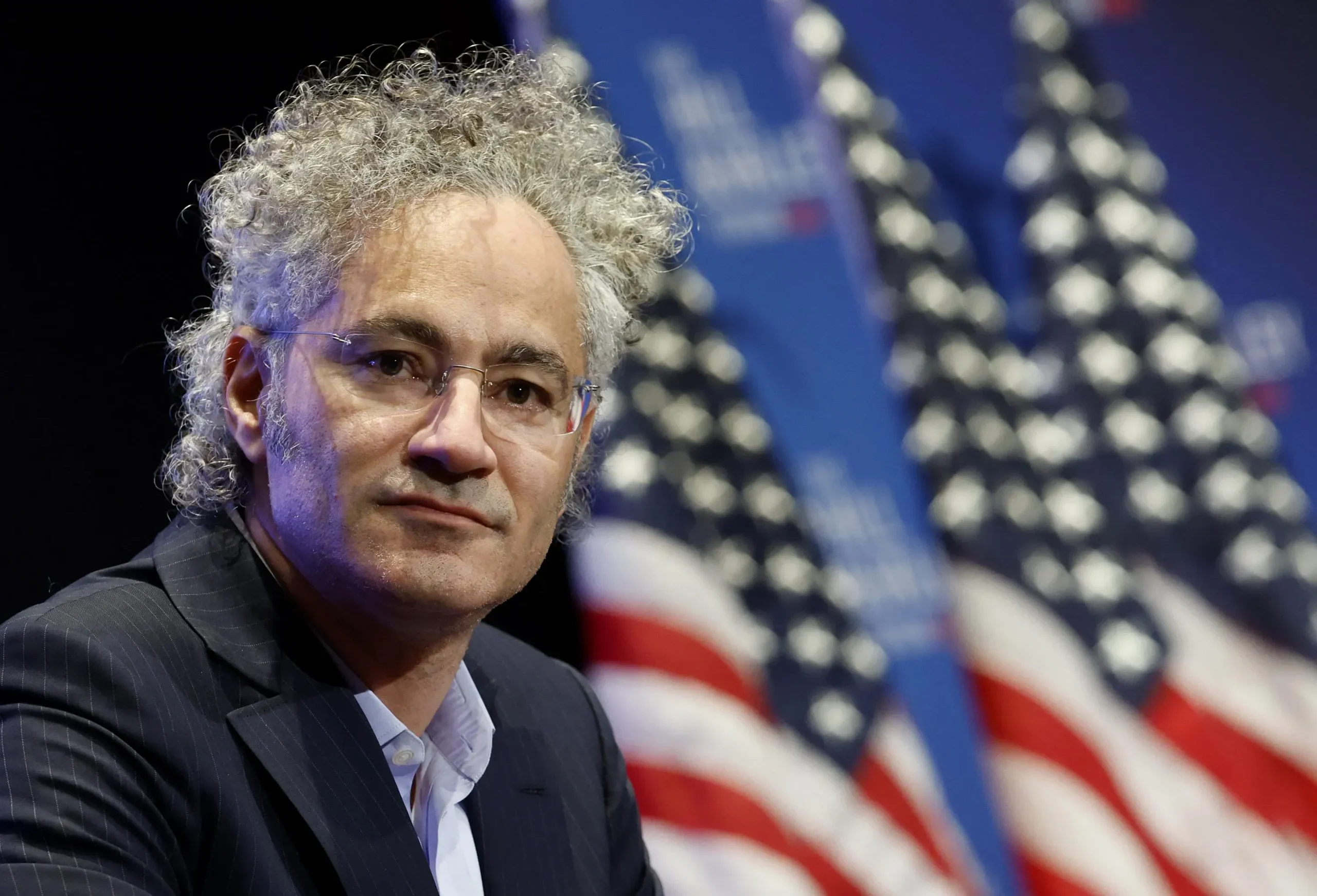
Palantir CEO Alex Karp said artificial intelligence can strengthen civil liberties while also transforming economies and labor markets, as Europe struggles to keep pace with faster-moving global rivals.
Speaking at the World Economic Forum in Davos, Switzerland, Karp joined BlackRock CEO Larry Fink for a wide-ranging discussion on how AI is already changing healthcare, work and geopolitics.
Karp explained that Palantir works with large numbers of hospitals, many of which face chronic shortages of doctors and nurses alongside inefficient patient intake systems.
According to him, hospitals often process patients differently depending on specialties, margins and capacity — a complexity that slows care and costs lives. AI-powered systems can streamline intake and operational flow, allowing hospitals to handle patients 10 to 15 times faster than before, which Karp said directly translates into saving lives.
Beyond efficiency, Karp argued that AI can improve fairness and accountability in healthcare. By tracking how and why decisions are made, AI systems can reveal whether patients are treated based on medical need rather than economic status or background — something he believes is impossible to measure without advanced data tools.
“We can clearly show why someone was accepted, redirected or rejected,” Karp said, adding that transparency benefits both patients and institutions.

Karp warned that the global AI race is creating a growing imbalance, with the United States and China far ahead of Europe in adopting and scaling advanced technology.
He said both countries have developed different but effective approaches to deploying AI at scale, and that progress is likely to accelerate faster than many expect. Europe, by contrast, faces what Karp described as a deep, structural problem with technology adoption.
What concerns him most, he said, is the lack of political leadership openly acknowledging the issue or presenting a serious plan to fix it.
Addressing concerns that AI could eliminate jobs, Karp pushed back on what he called a flawed Western narrative that automation will destroy employment.
He pointed to vocational and technical workers as an example, saying AI can rapidly increase their value rather than replace them. In industries like battery manufacturing, workers with high school educations are performing roles comparable to engineers abroad, made possible by advanced tools and data systems.
These jobs, Karp said, are becoming more valuable and harder to replace, not less.

Karp also suggested that AI-driven productivity could reduce the need for large-scale immigration in the future.
With technology enabling nations to upskill their existing workforce quickly, he argued that there may be enough jobs for citizens — particularly those with vocational training — without relying heavily on immigration, except in cases requiring highly specialized expertise.
While he acknowledged the political sensitivity of the topic, Karp said current AI trends make it increasingly difficult to justify mass immigration purely to fill labor gaps.

Overall, Karp framed AI as a force that can improve efficiency, fairness and opportunity — but only for countries willing to adopt it seriously. As the technology reshapes healthcare, labor and global competition, he warned that falling behind could carry long-term economic and political consequences.